
Future research is actually present research. R+T markets asked trend observer Mathias Haas what R+S specialist companies should prepare for in terms of outdoor living, smart home, sustainability and customer contact.
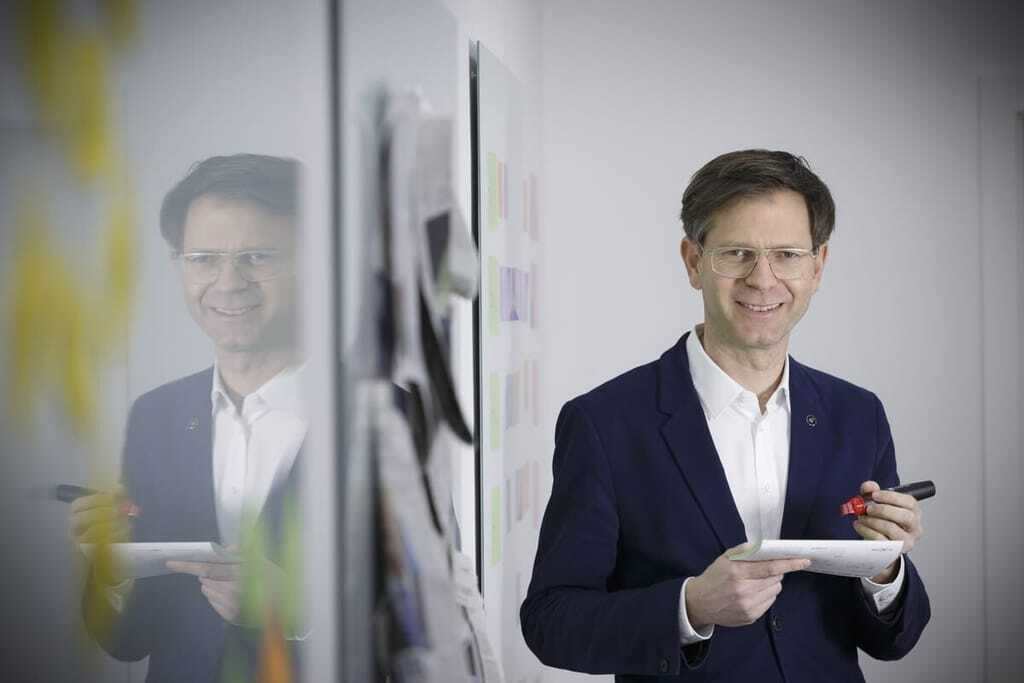
R+S specialist companies cannot complain about a lack of work at present. More and more people want to use their garden as an extended living space and need suitable sun protection systems for this. “People want to have another room outside, and that may well cost money,“ is how Stuttgart trend observer and futurologist Mathias Haas assesses this development. He believes that various factors will keep the demand for outdoor living solutions alive in the future.
Several drivers: outdoor living remains trendy
One driver for the sun protection industry is climate change, which inevitably requires investments in awnings, patio roofs or sun sails. “In order to withstand the heat on the terrace, appropriate solutions are in demand – one invests more, the other less,” says Haas. The natural need, so to speak, for sun protection solutions can be seen in conjunction with two points that are fuelling the outdoor trend and making people spend more time in the garden. One is a certain nature deficit, especially among people in the city.
In addition, there is the megatrend of New Work. According to Haas, companies will have to accept that employees will spend more time in the home office – also against the backdrop of the shortage of skilled workers, which has been intensified by Corona. Sometimes these would like to work outdoors there as well. “These people in particular will invest even more in the outdoors. Priorities are being shifted – and that creates budget,” Haas says. As he points out, the trend to work outdoors will even go so far that employers, primarily from the high-priced segment, will also create this possibility at their company headquarters itself. For R+S companies, this offers additional business opportunities.
Smart Home is coming on a massive scale
According to Haas, the products that specialist companies offer their customers should definitely include smart home components as well as sun protection systems. Their range is now huge, and in addition to conventional solutions for sun protection, lighting, heating or security, companies can round out their offerings with new types of products, such as a flyable indoor cam for home monitoring. “Smart home is a huge market. Here you can leave a lot of business on the street,” says Haas.
As the trend observer explains, the spread of smart home solutions will increase massively in the future. “It will take ten to 15 years for such products to become affordable, visually appealing and user-friendly,” says Haas. Only then will the trend become established and demand increase. The driver is the convenience of the user. In the future, insurance companies could also demand the use of corresponding solutions, e.g., for burglary prevention or for the protection of sun protection systems (wind monitor, rain sensor).
Focus on usability
In order to participate in the smart home trend, it is important for specialist companies to position themselves as premium providers and innovators in their region, says Haas. To do this, they need not only competent employees, but also products that impress with their usability and simple programming. “When asking what products I offer the customer, that would be the number one criterion for me as a specialist company,” Haas says. “It has to be simple.” Specialty retailers, he says, often go for the wrong products in this regard. Haas advises reviewing the own portfolio: “Maybe I have to part with my favorite supplier.”
Climate-friendly building as a lifestyle
What specialist companies should also include in their range, according to Haas, are products created through upcycling, such as awning fabrics made from PET bottles or fabrics made from marine plastics. “Sustainability is an uncanny driver. If you want to sell premium, you should have these kinds of products that come from the circular economy in your lineup today,” Haas says. Sometimes, in this context, it can also make sense for specialist companies to position themselves as a manufactory that restores existing building elements in old buildings, such as roller shutters, he adds. According to Haas, climate-friendly building and living is to some extent an expression of a lifestyle that is located in the affluent customer segment.
But even beyond that, environmental protection is gaining importance in the construction industry, he said. “The circular economy is slowly rolling in. It pays to reuse building materials not only for ecological reasons, but increasingly also for cost reasons,” says Haas. In his opinion, it is quite possible that the construction industry will be further pressured by legislative measures to reduce carbon dioxide emissions. End users, in turn, could be more enticed by government incentives to invest in climate-friendly and energy-saving technologies, which include the use of smart-controlled solar shading systems. “That’s one possible lever,” Haas says.
Acting customer oriented
All in all, the signs for the sun protection industry are favorable. However, every boom comes to an end, and R+S companies should be aware of this. They should therefore examine their behavior toward the end customer, which includes transparency in pricing and service culture. Just because the customer is happy that a tradesman is coming at all, Haas says, doesn’t mean he’s satisfied. “You don’t know how resentful the customer will be – even if he pays today.” In the worst case, he’ll never call again and won’t recommend you to anyone. Against this background, specialist companies should consider the values with which they want to operate on the market.
Gaining trust
To make the overall experience of purchasing a sun protection product as pleasant as possible for the customer, specialist companies can already use various digital tools. With the navigation app Waze, for example, companies share real-time information about their location via WhatsApp. This way, the customer knows exactly when the fitters will arrive. “This is a modern way of dealing with the customer and follows the spirit of the times,” says Haas. In this sense, he says, it is also advisable to send the customer photos of the construction progress should he not be at home himself. “You gain the customer’s trust that way.”
Use augmented reality
The corresponding tools and apps are available free of charge, unlike VR(virtual reality), AR(augmented reality) or MR(mixed reality) glasses. According to the trend observer, however, these are becoming increasingly cost-effective as well as user-friendly and for this reason alone will play a greater role in the future. “If you want to keep up with the times as a company, you should look into these technologies,” says Haas. R+S companies could use it, for example, to allow customers to experience the sun protection product and shade during the on-site consultation. “It’s equivalent to taking a test drive in a new car,” Haas says.
Another possible application is to be seen in particular, but not only, against the background of the shortage of skilled workers and the lack of sufficiently qualified employees. “The fitter on the construction site will be able to have his boss look over his shoulder if he gets stuck,” says Haas. None of this is a distant dream of the future; the possibilities are there and are just waiting to be exploited.